
Scaffold Loading Bay Installation (Progressive Method)
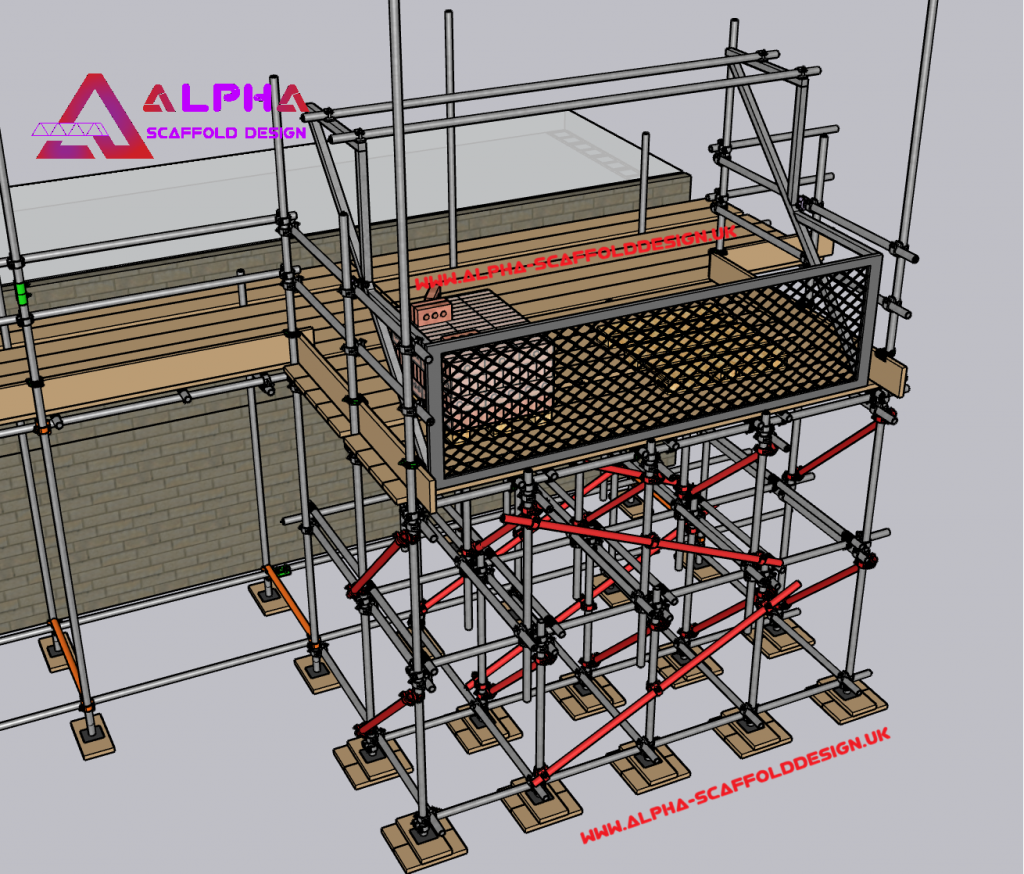
Step-by-Step Guide: How to Install a Progressive Scaffold Loading Bay + 3D model.

Scan the QR code to view the 3D model
Click the button for 3D view:
Use the 3D model to inspect:
– Sole boards
– ledger braces and façade braces
– check tubes
– double transoms next to standards or puncheons
Technical Author

Prepared by Mihai Rebenciuc, MSc Eng
Director & Lead Scaffold Design Engineer
Alpha Scaffold Design Ltd
- MSc Civil Engineering
- Over 20 years’ scaffolding and engineering experience
- More than 2,000 scaffold designs completed
- Specialist in complex scaffold engineering
- Design required: Yes
- TG20 compliant: No; site specific calculations required.
- Risk: High; when not installed to a design.
While this guide covers the progressive installation method, remember that all high-load structures must be built to an engineered specification. Alpha Scaffold Design provides expert scaffold loading bay design and TG20-compliant calculations for contractors across London and the UK.
Contact us with confidence:
Info@alpha-scaffolddesign.uk
Progressive Scaffold Loading Bay – Tips
Phase 1: The Base Up
Building a progressive scaffold loading bay requires strict attention to detail to ensure safety, compliance, and structural integrity under heavy loads. A common reason loading bays fail site inspections is due to improper transom setups or inadequate foundations.
Follow this step-by-step guide to correctly install a progressive loading bay, avoid common errors, and ensure a safe build from the ground up.
Step 1: Foundation and Bay Sizing
The stability of any heavy-duty scaffold structure begins at ground level. Because loading bays are subjected to exceptionally high loads, standard base setups are often insufficient.
- Foundation: A pyramidal soleboard arrangement is highly recommended to properly distribute the massive weight and high loads transferred through the standards.
- Bay Dimensions: For optimal structural integrity, keep your bay sizes compact. You won’t go wrong with a 1m long by 1m wide setup, though 1.2m wide bays are also standard practice depending on design and loading.
Step 2: Bracing the First Lift
Once your foundation is set and the kicker lift is complete, aggressive bracing is required to prevent any lateral movement or twisting.
- Ledger Bracing: Ledger braces must be installed in every single bay without exception.
- Sway / Facade Bracing: Sway braces (or facade braces) should also be installed in every bay. For the best structural stability, these should ideally span over two bays.
Step 3: Check Tube & Transom Installation (Avoiding Common Errors)
A frequent error that causes scaffold loading bays to fail safety inspections is the missing Check fitting or check tube or the single transom to support the bay.
- Check Tubes: Do not forget your check tubes. It is paramount to add the check tubes under the ledger, a critical step before boarding.
- The Transoms Solution: Always use double transoms. Install them on either side of the standards to properly support the heavy loads that will be placed on the boards.
Once these steps are complete, the structure is ready to be boarded, and Phase 1 is complete for loading.
Phase 2: The Progression Stage
As the main scaffold rises, your loading bay must progress upwards with it. Here is how to execute the progression phase safely:
Step 1: Remove The Transoms
- Begin by removing all or some of the transoms from the lower level to make room for the new puncheons.
Step 2: Install Puncheons
- Install the puncheons right next to the standards, securing them with double couplers for maximum grip.
Step 3: Bottom Check Tubes
- Pro-Tip: Add a check tube directly on top of the bottom ledger. This is a better alternative to the check fitting alone.
Step 4: Fully Brace
- Ensure all the newly progressed bays are fully braced again, following the same ledger and sway bracing rules from Phase 1.
Step 5: Top Check Tube
- Add another check tube just below the top ledger to every bay.
Step 6: Double Transoms
- Final Double Transoms: Finish the progression by installing your double transoms to either side of the puncheons and as close as possible to the puncheons to prevent overloading the ledger at the new height.
- The progression is now ready to be boarded and loaded at the new working lift.
Successive progression phases can be added with the same sequence.
- Plan braces may be needed for multiple levels.
Always install Loading Bays to an engineered design or compliance sheet.
Please note: This is a training/illustration example.
Professional Scaffold Loading Bay Design Services
While mastering the correct scaffold loading bay installation sequence is crucial for your site teams, ensuring the structure is legally compliant requires expert engineering. At Alpha Scaffold Design, we provide comprehensive scaffold loading bay design services tailored to the exact requirements of your construction site.
Because loading bays may be required to support heavy materials such as bricks, blocks, and site equipment, our specialist engineers calculate precise Safe Working Loads (SWL) to guarantee structural integrity under pressure. We manage the complete temporary works design process from start to finish.
When you partner with us, you receive:
Fast & Reliable Turnarounds: We know delays cost money, which is why we deliver high-quality, practical designs that work seamlessly on-site.
Fully Compliant Engineering: We ensure every structure meets strict UK safety regulations, TG20 guidelines, and local site standards.
Clear easy-to-read designs: We provide crystal-clear CAD drawings using specific scaffolding terminology so your scaffolders know exactly what to build, eliminating guesswork.
For enquiries: Info@alpha-scaffolddesign.uk or WhatsApp: 07896979966
Below you can watch a quick YouTube reel
❓ Scaffold Progressive Loading Bay – FAQ
Q1: Why are loading bays more prone to failure during inspections?
Because of improper transom arrangements, missing check tubes, and inadequate foundations. These elements are critical for handling high loads safely.
Q2: What is the recommended bay size for a loading bay?
Compact bays perform best. A 1.0m x 1.0m bay is ideal, while 1.2m width may be used depending on design and loading requirements.
Q3: Why are double transoms required?
Double transoms provide proper load distribution and reduce stress on ledgers. Single transoms are a common cause of failure under heavy loading.
Q4: Are check tubes really necessary?
Yes — they are essential. Missing check tubes is one of the most frequent inspection failures. They improve load transfer and prevent movement.
Q5: How much bracing is required in a loading bay?
Loading bays require full bracing in every bay:
- Ledger bracing in all bays
- Sway/façade bracing throughout (ideally over two bays)
Q6: What is the purpose of puncheons in the progression stage?
Puncheons transfer loads vertically as the loading bay progresses upward, ensuring stability at higher lifts.
Q7: Can a loading bay be built using standard scaffold practices?
Not always. Loading bays carry significantly higher loads and require enhanced foundations, tighter bay sizes, and additional components compared to standard scaffolds.
Q8: Is this guide a substitute for scaffold design?
No. This is a training/illustration example. Final arrangements must follow the project design brief, temporary works controls and the issued scaffold design.
Q9: Where can I view the 3D model?
Use the “View model in 3D” link (or the QR code on the page) to open the interactive model in Trimble Connect.